Recent comments in /f/space
[deleted] t1_jdydfgd wrote
Reply to Why don’t we use Venus as a dumpster? by Postnificent
[removed]
pmMeAllofIt t1_jdyd4hm wrote
Reply to comment by Postnificent in Why don’t we use Venus as a dumpster? by Postnificent
Nuclear rockets won't "ignite" until they're in a nuclear safe orbit, and it will be on a escape trajectory away from Earth. And a large rocket as you propose likely won't be able to have any prolonged operation in LEO, it would be above where the majority of debris is.
All of this ignores the simple fact that this isn't a video game, you don't just drive around picking up trash. You can use it to send trash away once you collect it, but it's not even remotely a good proposal on how to collect it.
WhosAlex992 t1_jdycmz5 wrote
Reply to comment by atika in Why don’t we use Venus as a dumpster? by Postnificent
Oh, interesting, I did not know that.
VoraciousCoprophage t1_jdycge6 wrote
Reply to comment by Postnificent in Why don’t we use Venus as a dumpster? by Postnificent
I mean to be fair 'scientists have lied about Venus atmosphere' is about as good of an idea as 'we should send space trash to Venus'...
atika t1_jdycg7s wrote
Reply to comment by WhosAlex992 in Why don’t we use Venus as a dumpster? by Postnificent
Venerian or venusian, but definitely not venetian, unless you're talking about Venice.
VoraciousCoprophage t1_jdyc6qm wrote
Reply to comment by Postnificent in Why don’t we use Venus as a dumpster? by Postnificent
"Unless"... Hey nobody tell him, just let him see it...
(Hahah joking, but yea. If we send our trash to another planet for 100 years, and then 1000 years, and then 5,000 years... How much mass will we have lost? We will literally be using all our resources to... throw our resources away. We will have to then start using more resources to capture asteroids for metal. The metal was already there, we just sent it away out of temporary convenience.)
Kenshkrix t1_jdyapre wrote
Reply to comment by BailysmmmCreamy in Are galaxies just giant accretion disks around super massive black holes? by darthvadercock
I lean towards the "seed" idea, because black hole formation and growth as we understand it requires that supermassive black holes had to form already extremely massive relative to an 'ordinary' black hole.
A sufficiently energetic collapse to cause a supermassive black hole straight out is extremely unlikely to occur if things are already in any kind of orbit.
We still don't really know, but it's pretty interesting nonetheless.
Tao_Te_Gringo t1_jdyakhr wrote
Reply to comment by Head_Weakness8028 in Why don’t we use Venus as a dumpster? by Postnificent
Congrats on hitting the lottery in the Dad Draw.
Consistent-Chip8908 t1_jdyajnk wrote
Reply to comment by tr14l in Why don’t we use Venus as a dumpster? by Postnificent
And if you don't hit it properly, it can come back like an asteroid. An asteroid full of your own toxic wastes flying uncontrollable in the solar system, ready to hit earth again.
thawed_froyo t1_jdyae82 wrote
Reply to comment by Nerull in Are galaxies just giant accretion disks around super massive black holes? by darthvadercock
Would that not have a ripple effect, even if it takes billions of years?
remchien t1_jdya4ce wrote
Reply to comment by AlphaDrac in James Webb Space Telescope finds no atmosphere on Earth-like TRAPPIST-1 exoplanet by locus_towers
While usually true, in this case they used MIRI to measure the amount of missing heat when the planet was behind the star as opposed to next to it. A secondary eclipse instead of a transit. They can then make assumptions about the atmosphere with that measured temperature and the fact that it is a tidally locked planet.
AGARAN24 OP t1_jdy9lyb wrote
Reply to comment by Rhoihessewoi in Discussion on Time relativity near black holes by AGARAN24
So cool.
[deleted] t1_jdy9959 wrote
[removed]
Nerull t1_jdy9585 wrote
Reply to comment by thawed_froyo in Are galaxies just giant accretion disks around super massive black holes? by darthvadercock
For us, essentially nothing. Some stars extremely close to the galactic core might have their orbits disrupted, but we might not even notice.
[deleted] t1_jdy8vz2 wrote
Reply to comment by BailysmmmCreamy in Are galaxies just giant accretion disks around super massive black holes? by darthvadercock
[removed]
jaibhavaya t1_jdy8uyq wrote
Reply to comment by theboehmer in Are galaxies just giant accretion disks around super massive black holes? by darthvadercock
Yea! That’s certainly how I understand it. I was curious how that fit into the black hole contributing little to holding the galaxy together as commented. Maybe it just plays a larger part in the early formation of the galaxy.
Nerull t1_jdy8gyp wrote
Reply to Hypothetical question by jd-sutton
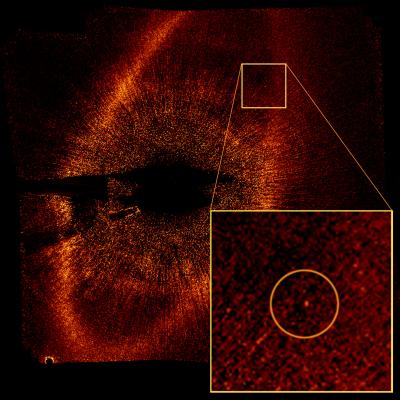
From 100ly JWST would see Earth as a single pixel dot, if it could seperate it from the sun's glare at all.
Here's a planet 25ly away from the Hubble Space Telescope:
https://www.universetoday.com/wp-content/uploads/2008/11/fomalhaut-planet.jpg
wicklowdave t1_jdy84bc wrote
Reply to comment by Postnificent in Why don’t we use Venus as a dumpster? by Postnificent
that tech isn't classified, is it?
collegefurtrader t1_jdy83oe wrote
Reply to comment by Trinull in Hello everyone . I am very interested in space megastructure. such as mckendree cylinder or bishop rings. But suppose we built it. How can a spacecraft dock with it ? Knowing that these huge structures rotate at huge speeds to generate a gravitaty similar to Earth's by Dizzy_Ad3353
I could see a proboscis with a bunch of docking ports and a slip ring connection that cancels the rotation. Then you can dock more than 2 things.
SavemebabyK t1_jdy7whx wrote
Reply to Why don’t we use Venus as a dumpster? by Postnificent
I appreciate your thinking. The idea is appealing. I think we are already heading into that direction Universally speaking.
[deleted] t1_jdy7usy wrote
Reply to Hello everyone . I am very interested in space megastructure. such as mckendree cylinder or bishop rings. But suppose we built it. How can a spacecraft dock with it ? Knowing that these huge structures rotate at huge speeds to generate a gravitaty similar to Earth's by Dizzy_Ad3353
[removed]
IowaContact2 t1_jdy7po0 wrote
Reply to Why don’t we use Venus as a dumpster? by Postnificent
Tell us all repeatedly how you don't understand basic science and physics and all that fun stuff without admitting you don't understand basic science and physics and all that fun stuff.
[deleted] t1_jdy7pe4 wrote
Reply to Why don’t we use Venus as a dumpster? by Postnificent
[deleted]
IcERescueCaptain t1_jdy7991 wrote
Reply to Why don’t we use Venus as a dumpster? by Postnificent
Or the junk Hyperloops around the Sun and crashes back to Earth at Mach 10 000…….
ifeelmy t1_jdydnqh wrote
Reply to comment by simcoder in Space Force should prepare for the threat we have — not the one we prefer | TheHill by Corbulo2526
Because we are so good at sharing and not oppressing each other. Morality is learned. They could be good lessons or bad ones. But World leaders don't give me much hope.